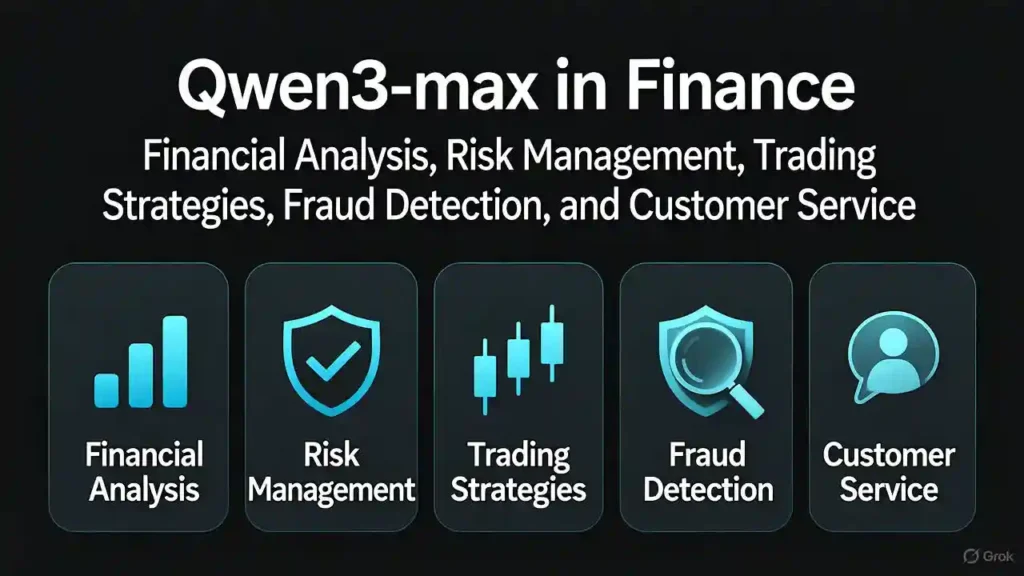
In modern finance, precision and speed define competitive advantage. Qwen3-Max enables financial institutions to achieve both by applying advanced AI to fraud detection, risk analysis, and algorithmic trading. Its ability to process structured and unstructured data in real time allows banks to detect anomalies, manage compliance, and generate insights at scale. This article explores practical applications of Qwen3-Max in financial operations and how it helps reduce losses while improving efficiency.
Full Qwen3 Max Overview And Capabilities
Fraud Patterns: Real-Time Flags
Fraud detection remains one of the most complex challenges in banking. Qwen3-Max helps institutions identify irregular transactions through continuous pattern recognition. Instead of relying on fixed thresholds or static rules, it adapts dynamically to behavioral data.
For example, Qwen3-Max can evaluate thousands of transaction attributes per second—location, frequency, and device ID—and compare them to typical customer behavior. When inconsistencies appear, the model flags them instantly, prompting review teams to act before significant losses occur. This real-time monitoring reduces both false positives and response delays, improving overall fraud prevention accuracy.
Credit Risk: Feature Stores & Scoring
Credit risk management benefits significantly from Qwen3-Max’s ability to handle diverse datasets. It combines structured records like credit history and income data with unstructured sources such as text-based reports or customer feedback.
By leveraging feature stores, Qwen3-Max produces a more comprehensive borrower profile and a dynamic credit score. Financial institutions can detect subtle risk indicators—like spending volatility or repayment trends—before they escalate into defaults. The outcome is a faster, more precise lending process that minimizes exposure and supports responsible credit expansion.
Algo Trading: Signal Ingestion & Backtests
Algorithmic trading depends on data speed and interpretability. Qwen3-Max enhances these systems by ingesting real-time market signals, executing sentiment analysis, and running backtests across historical datasets.
A trading firm using Qwen3-Max can automatically adjust strategies when volatility spikes or macroeconomic news breaks. For instance, if sentiment around a specific stock turns negative, Qwen3-Max can detect the shift early and trigger a hedge strategy.
Its integration with Long Context & RAG frameworks allows models to maintain awareness across large data windows—connecting multiple events that influence market behavior—thus improving decision consistency and trading accuracy.
KYC/AML Reviews: Document Parsing
Know Your Customer (KYC) and Anti-Money Laundering (AML) compliance consumes substantial time and resources. Qwen3-Max streamlines these workflows by automating document verification and text extraction.
Using advanced natural language processing, it scans IDs, bank statements, and transaction logs, identifying discrepancies or incomplete information. Compliance teams can then focus only on flagged cases instead of manually reviewing every document. This not only accelerates onboarding but also ensures adherence to strict regulatory standards—an essential feature for global institutions with multiple jurisdictions.
Claims & Disputes Automation
Banks and payment processors handle thousands of claims and disputes daily. Qwen3-Max classifies these cases by type, extracts evidence, and drafts preliminary responses based on internal policies.
By generating structured summaries and resolution suggestions, it minimizes human intervention in repetitive cases. The system can even cross-check dispute histories and detect patterns linked to fraudulent activity, further strengthening overall security.
This automation aligns closely with Security & Compliance strategies, ensuring that sensitive data remains protected while maintaining operational efficiency. The ability to process information securely within regulated boundaries helps institutions meet auditing requirements without sacrificing performance.
Reporting: Narrative Generation
Financial reporting requires consistency, precision, and clarity. Qwen3-Max automates narrative generation for management dashboards, investment summaries, and audit logs.
Instead of manually drafting reports, analysts can use Qwen3-Max to convert large datasets into clear, human-readable insights. The AI can summarize daily performance trends, highlight anomalies, and even suggest contextual explanations.
For instance, after a volatile market session, the system can produce a concise risk summary outlining key drivers behind profit or loss. This shortens reporting cycles and enhances decision-making speed.
Cost Ops: Token Budgets & Caching
Financial teams adopting AI models often face growing compute expenses. Qwen3-Max addresses this challenge with token budgeting and caching optimization.
By reusing repeated queries and applying shorter prompts where possible, institutions can control inference costs. The formula for monitoring efficiency can be expressed as:

Organizations can track token efficiency metrics and fine-tune their systems for maximum performance. Over time, these optimizations can reduce monthly API expenses by up to 25%, while keeping response quality consistent.
Conclusion
Qwen3-Max is redefining how banks manage risk, detect fraud, and analyze markets. Its real-time intelligence, document automation, and operational efficiency provide a clear competitive edge in a sector where milliseconds matter.
From adaptive fraud detection to automated reporting, Qwen3-Max brings together scalability and precision—empowering financial institutions to move faster and make smarter decisions. As adoption grows, the model’s capabilities will continue to expand, shaping the future of finance through AI-driven intelligence.